

Impressed current, off the grid.
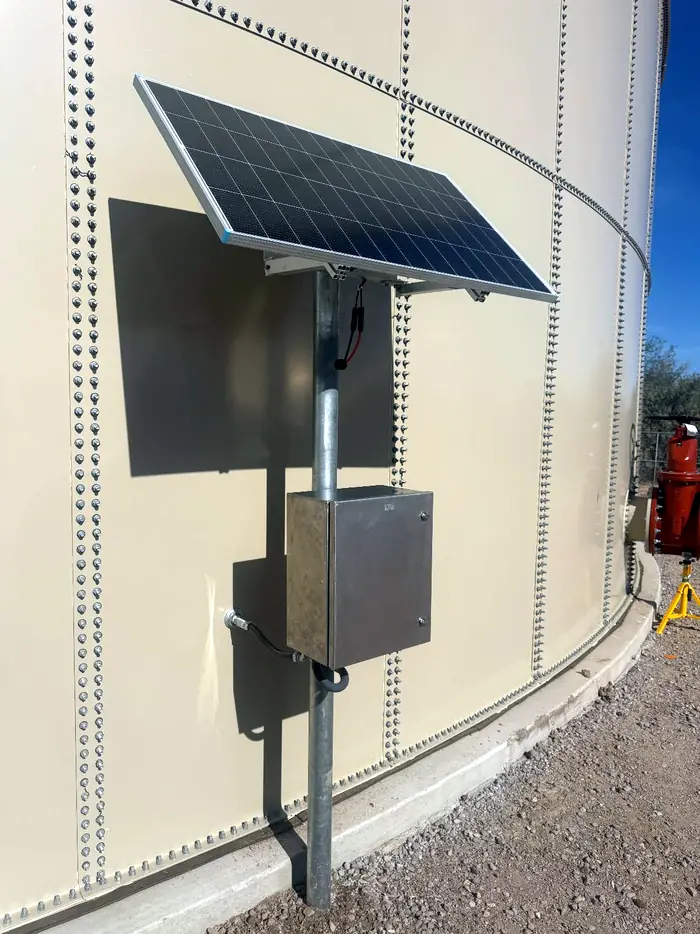
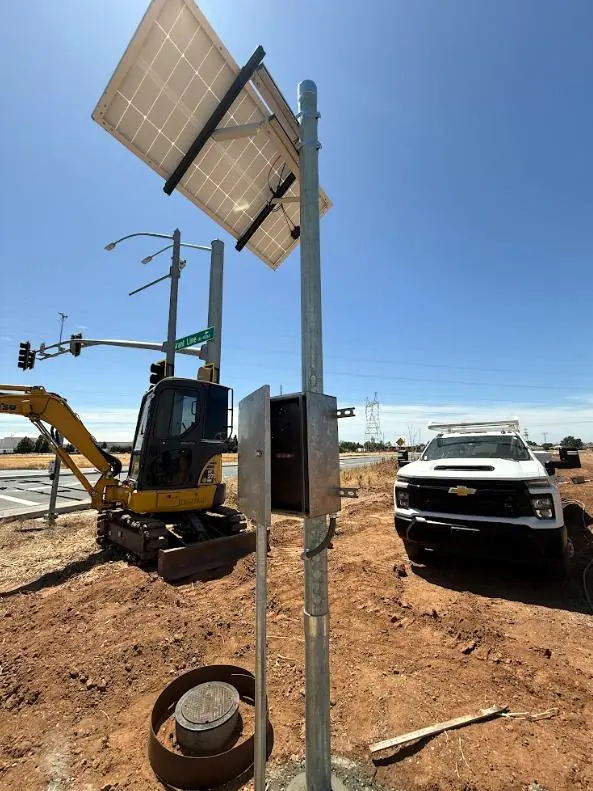
The PV DC Impressed Current Controller is our own solar-powered rectifier for cathodic protection. It puts a regulated DC current source on the asset itself — no utility service, no meter, no trench to a panel — and holds the structure at criterion on a 200 W module and a lithium battery.
The problem
On most sites, the power is the expensive part.
Remote tanks and pipeline test stations rarely sit next to a service. Getting a rectifier energized the conventional way means a utility application, a trench, a meter and a standing charge — often the largest single line item in the project, and months of it before any current flows.
Nothing to apply for
The current source sits on the asset it protects. No utility application, no easement for a service run, no coordination with a third party before commissioning.
Nothing to meter
A conventional rectifier draws power for the life of the asset and bills for it monthly. A PV unit has no recurring energy cost at all.
One post, one crew
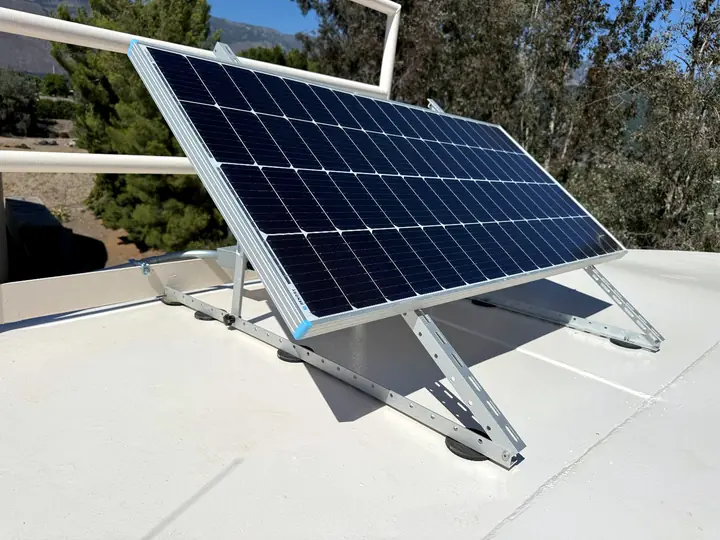
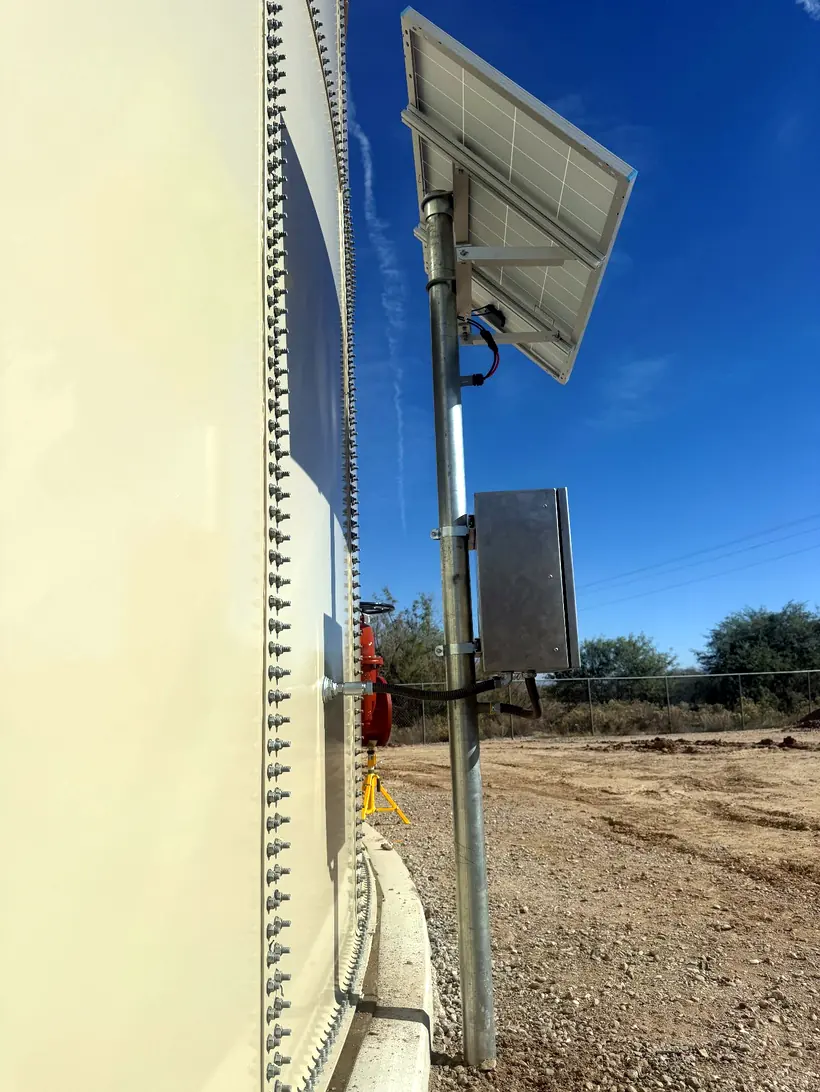
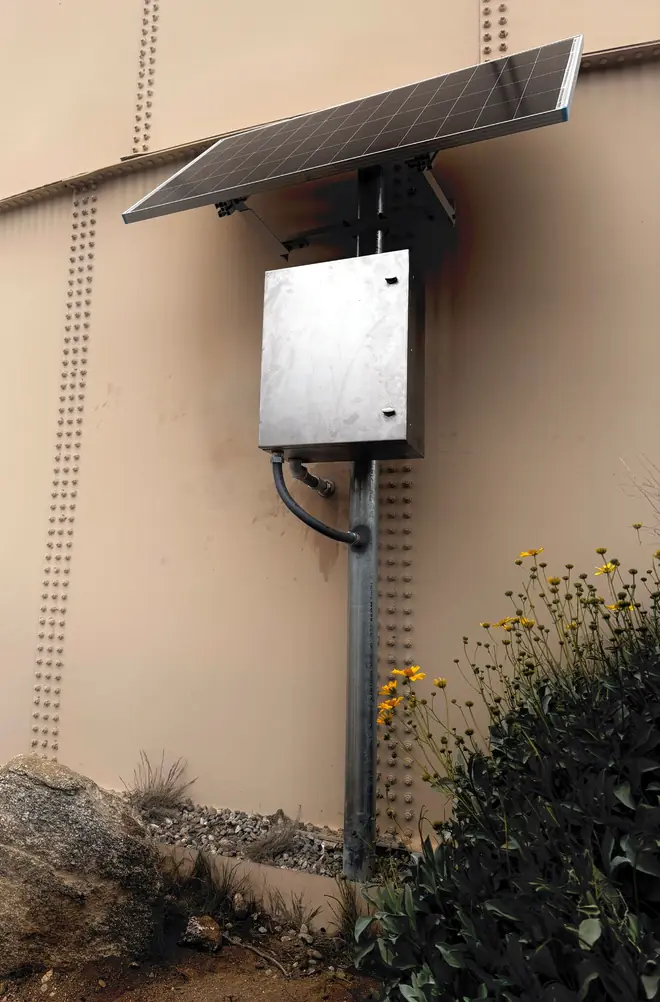
Module, controller and battery mount to a single concrete-filled galvanized post, or straight to the tank. Set, wire, commission — the same visit.
Collect
A south-facing 200 W monocrystalline module charges the battery through the controller.
Store
A 12 V 100 Ah lithium iron phosphate bank carries the system through night and overcast.
Regulate
The controller holds a set DC output — by voltage or by current — onto the anode ground bed.
Protect
Current returns through the electrolyte onto the structure and holds it at the −850 mV criterion.
Three sizes
Sized to the current the structure actually needs.
Output is set from the design calculation — surface area, coating condition and current density. We size the module and the battery to the duty, so the unit still delivers on a short winter day.
Water storage tanks and short pipe runs. Compact, and the least steel on the post.
Price on requestMedium to large water tanks and medium-scale underground pipe. The size most of our tank work lands on.
Price on requestLarge tanks and extensive pipeline networks — where the ground bed needs real driving voltage.
Price on requestOutput limits are set in the controller as over-voltage and over-current protection, so a unit cannot be driven past its rating in the field.
Inside the cabinet
Everything a technician needs, on the door.
A stainless NEMA 4X enclosure with the meter, the isolators and the test points laid out so a routine check takes minutes and never needs the cabinet opened up.
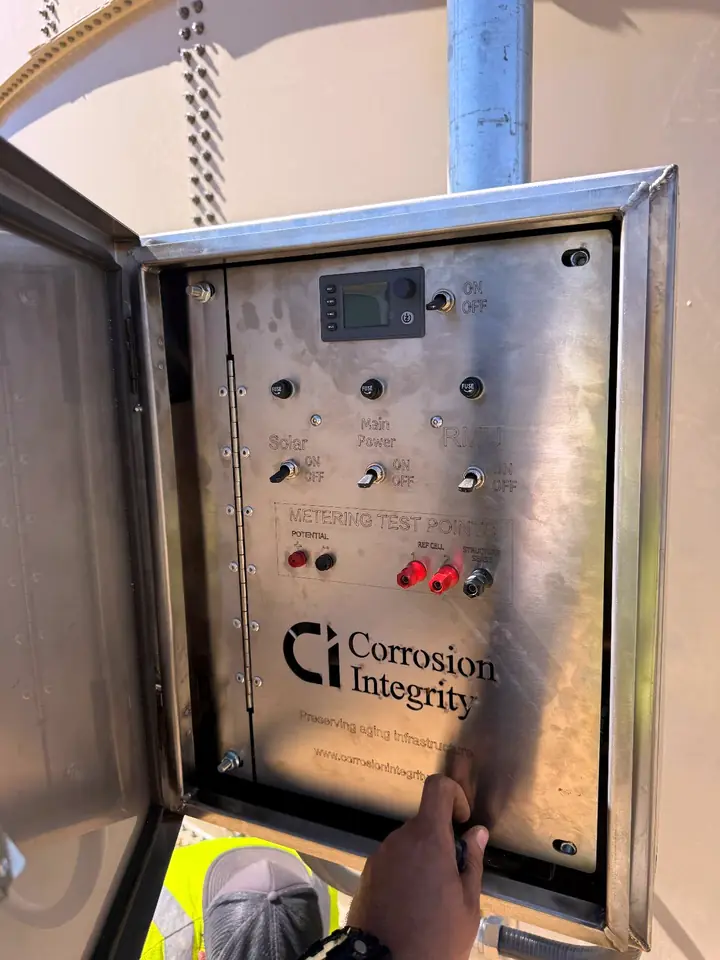
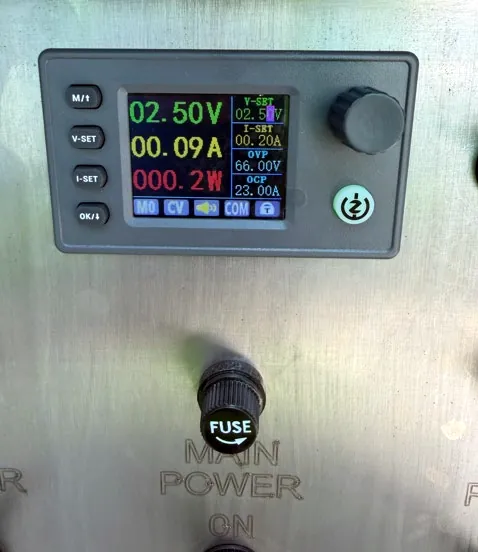
- Digital output meter. Volts, amps and watts live, with V-SET and I-SET adjustment and over-voltage / over-current limits held in the controller.
- Three isolators. Solar, Main Power and RMU switch independently, so the array or the monitoring can be taken out without dropping protection.
- Fused throughout. Each of the three circuits carries its own fuse at the panel.
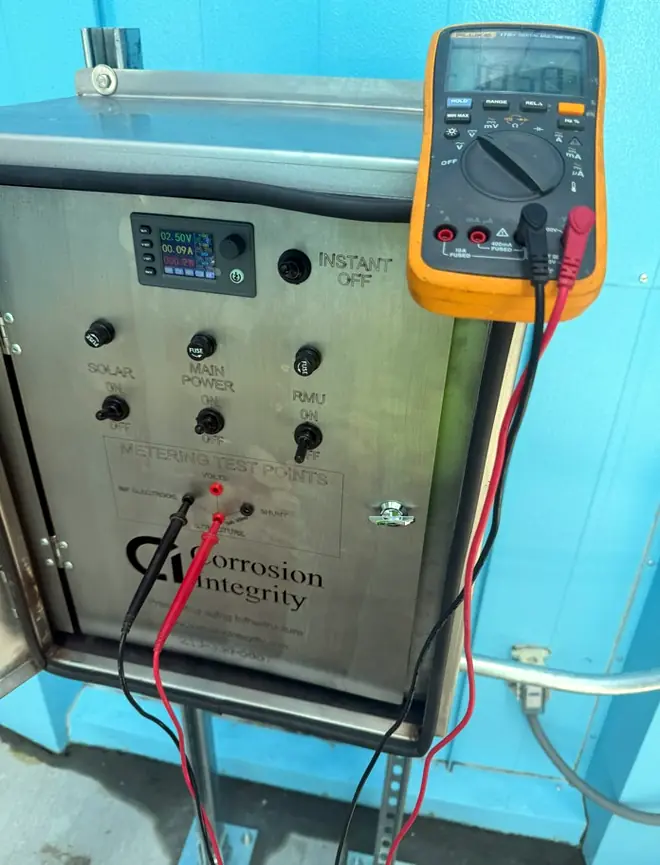
- Metering test points. Volts, Ref Cell, Structure and Shunt terminate on the door — structure-to-soil and instant-off readings without breaking into the wiring.
- Legible thresholds. The door carries the numbers that matter: if output falls below 0.50 V or 0.01 A, something has changed and we want the call.
- Stainless throughout. NEMA 4X rated, rated for −40 °F to 140 °F, and it still looks like this after a summer in Arizona.
| Output | 12 V 5 A · 12 V 10 A · up to 24 V 22 A |
|---|---|
| Regulation | Constant voltage or constant current, set at the panel |
| Protection | Over-voltage and over-current limits; fused solar, main and RMU circuits |
| Enclosure | Stainless steel, NEMA 4X, padlockable |
| PV module | 200 W high-efficiency monocrystalline, 41.8″ × 20.9″, south facing |
| Storage | 12 V 100 Ah LiFePO4 with integral BMS — 7,000+ cycles at 100% DOD |
| Test points | Volts, reference cell, structure, shunt |
| Output wiring | #10 THHN pair in ¾″ liquid-tight; 18 ga 3C shielded for structure sense |
| Mounting | 3″ concrete-filled galvanized post, 3 ft below grade in concrete; cabinet at 5′-6″. Tank-mounted where the structure allows. |
| Monitoring | Optional cellular RMU; satellite for sites with no coverage |
| Installation | Per NEC. Drawings stamped by a NACE-certified CP Specialist. |
Remote monitoring
Know it is still running without driving to it.
A rectifier that has quietly stopped is worse than no rectifier — the structure is unprotected and nobody knows. Every unit can be ordered with a remote monitoring unit that reports output and raises an alarm the day it changes.
- Cellular by default. The RMU reports over the cell network with a 24/7 web interface behind it.
- Satellite where there is no cell. For genuinely isolated sites, a satellite-connected unit gives the same reporting.
- Compliance measurements. Dedicated analog channels for rectifier voltage and current — the readings a survey record needs.
- Alarm on failure. Notification when output drops, rather than finding out at the next annual survey.
- Independently powered. Battery, AC or DC, with surge-resistant circuitry, and its own isolator on the panel.
Field record
In service on tanks and pipelines across California and Arizona.
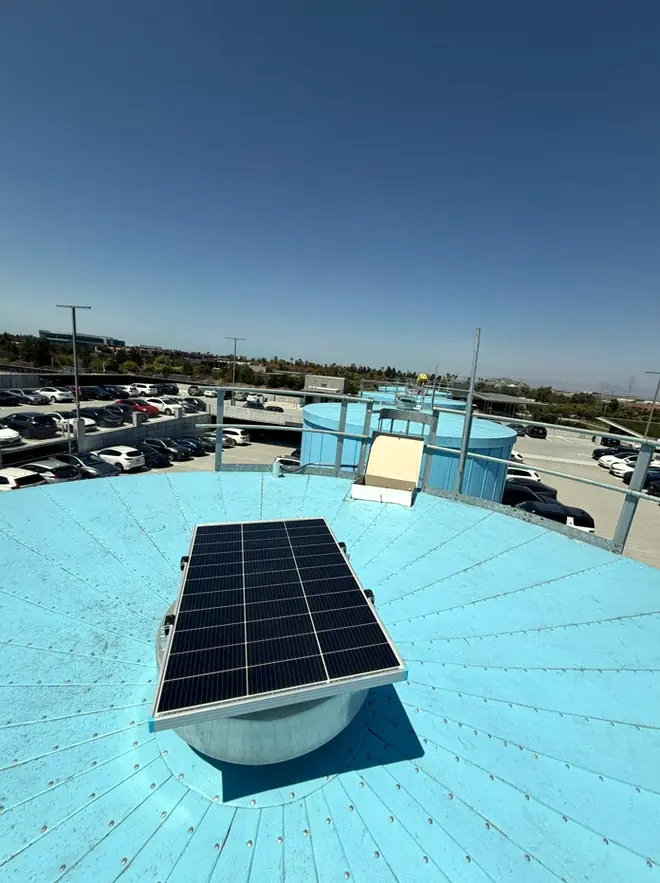
Welded reservoirs, bolted tanks, municipal and campus water systems, and a new sewer force main — designed, built, installed and commissioned by us. Every one came with stamped drawings, a commission report and an ICCP operations and maintenance manual.
Get a number
Tell us the structure and we will size it.
Send the asset type, the dimensions, the coating condition and whether there is power at the site. We come back with the current requirement, the controller size, the module and battery, and a price — including the anode ground bed if you need the whole system.
Every system ships with stamped design drawings, an installation and commission report, and an ICCP operations and maintenance manual.
Service request
Tell us what you are protecting.
We visit the site before we estimate. Send the structure, the environment and what you already know — an engineer will come back to you, not a call center.
Northern California
3837 Howsley RdPleasant Grove, CA 95668
Northern Arizona
Flagstaff, AZ 86001